Nine Generations · One Mission

The Future of American Ginseng Begins in the Soil of the Past

Integrating ancestral ecological knowledge with proprietary habitat science to conserve, restore, and cultivate Panax quinquefolius for the next century.

Explore Our Work

Two Legacies. One Purpose.

Trent Smith, Founder of Ginseng Legacy

Trent Smith

Founder & Executive Director

Ginseng Legacy represents the convergence of generational knowledge and organizational mission, dedicated to ensuring that American ginseng thrives for the next century and beyond.

A ninth-generation Tennessean whose family has maintained an unbroken relationship with the Appalachian landscape since 1824, Trent Smith is the sole living repository of nine generations of place-based ecological knowledge spanning the watersheds of Middle Tennessee. With a background in Environmental Studies and Geography, he has developed proprietary Habitat Suitability Models that translate ancestral knowledge into verifiable, data-driven conservation tools.

The Individual

Trent Smith

"My 6th great-grandmother kept this knowledge alive through two centuries of change. I carry it forward not as tradition, but as science."

His work bridges the gap between traditional ecological wisdom and modern geospatial science, creating approaches to ginseng conservation that no institution or algorithm alone could replicate.

Trent is a social entrepreneur who believes that conservation must generate economic value to be sustainable. His vision extends beyond preservation to the creation of a new model for rural economic development rooted in ecological stewardship.

The Organization

Ginseng Legacy

"A resilient Appalachian landscape where thriving ginseng populations anchor biodiverse forest ecosystems and support vibrant rural economies."

Ginseng Legacy is dedicated to the preservation, restoration, and sustainable cultivation of American ginseng and associated forest ecosystems in the Appalachian region.

Through science-driven conservation, strategic land management, and community engagement, Ginseng Legacy implements practical solutions while creating sustainable economic opportunities for rural communities across Appalachia.
"Preserving biodiversity and cultural heritage by integrating multi-generational ecological knowledge with modern conservation science to restore American ginseng populations and associated forest ecosystems while creating sustainable economic opportunities for rural communities."

Ginseng Legacy

Proprietary Habitat Intelligence

Our Habitat Suitability Model translates nine generations of ecological observation into a verifiable, high-resolution geospatial tool. This is not a theoretical exercise. It is a proven system with documented accuracy of 0.9 to 1.0 in field validation.

The Habitat Suitability Model

Built from meticulous analysis of geospatial metadata collected across Tennessee watersheds, the HSM identifies microhabitat characteristics that determine ginseng viability at the sub-watershed level. The model integrates soil chemistry, canopy structure, aspect, elevation, moisture regimes, and historical ecological indicators.

What makes this model unique is its foundation. It is not derived from literature reviews or remote sensing alone. It is built on ground-truth data collected through direct observation across generations of ecological engagement with specific landscapes. This is knowledge that cannot be replicated by any institution, algorithm, or dataset.

Intellectual Property

The HSM represents proprietary intellectual property with applications across conservation planning, sustainable agriculture, land management, and biodiversity credit markets. Its high-resolution focus on specific sub-watersheds provides actionable intelligence for landowners, agencies, and investors seeking verified habitat data.

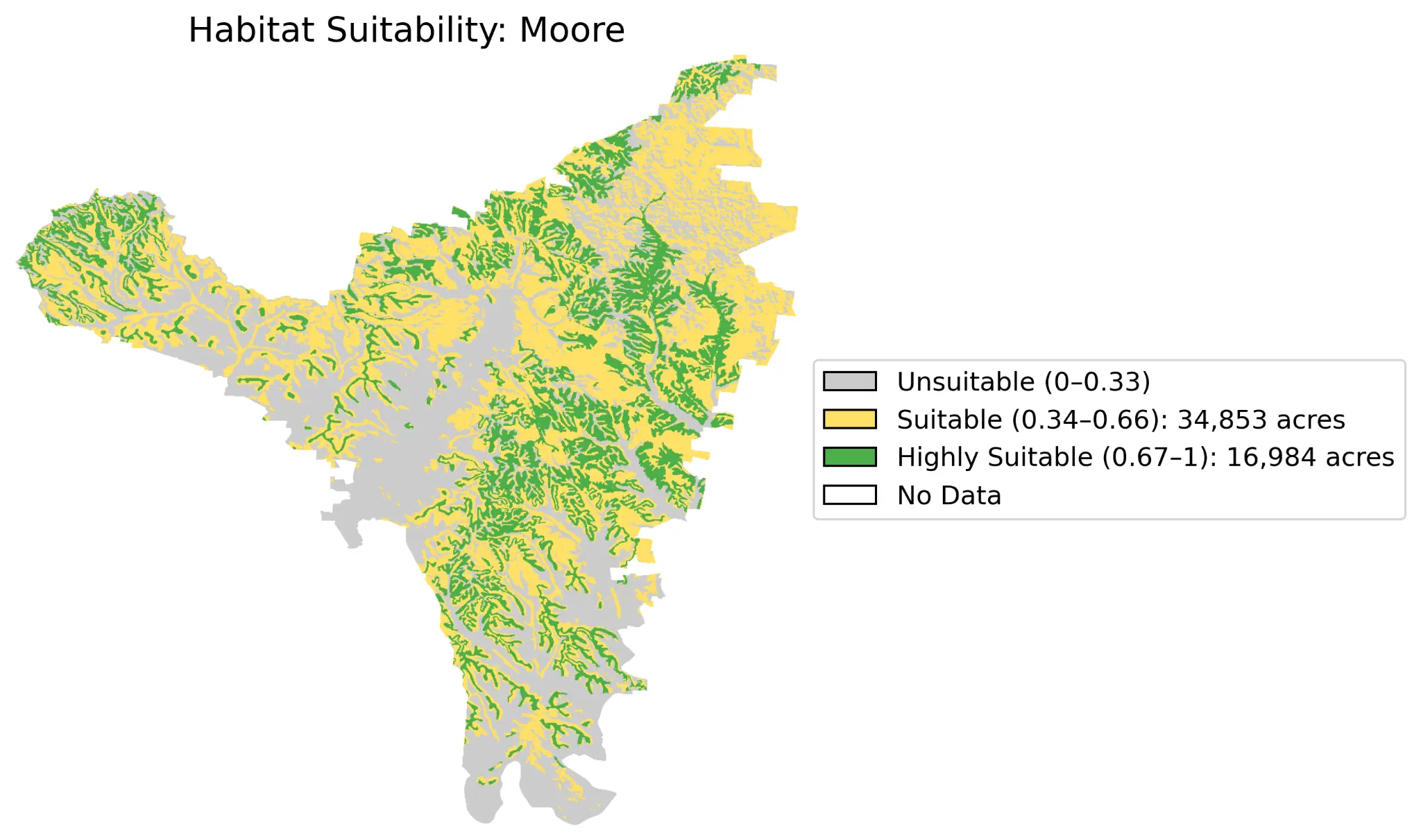
Habitat Suitability Model - Moore County, Tennessee

Habitat Suitability Model output for Moore County, TN. Green indicates highly suitable habitat (0.67-1.0): 16,984 acres identified. Yellow indicates suitable habitat (0.34-0.66): 34,853 acres identified.

0.9–1.0
Model Accuracy (Validated)
9
Generations of Knowledge
50,000+
Acres Mapped

A National Strategy for American Ginseng

American ginseng was once so abundant it was the first export of the independent United States. Today, only 24,000 pounds are harvested nationally. We are building the infrastructure to reverse this decline through science, propagation, and strategic land management.

01

National Genetic Repository & Propagation Hub

A centralized Plant Tissue Culture facility serving the entire species nationally. Rather than fifty scattered labs, one world-class hub preserving genetic diversity and producing locally adapted planting stock for conservation and cultivation across the Appalachian range.

02

Landscape-Scale Conservation

Deploying the Habitat Suitability Model across Tennessee and the broader Appalachian region to identify, protect, and restore critical ginseng habitat on both public and private lands. Working with agencies, landowners, and conservation organizations to implement data-driven restoration at scale.

03

Rural Economic Engine

Creating a sustainable wild-simulated ginseng industry that generates meaningful income for rural landowners while incentivizing long-term forest conservation. Premium American ginseng commands $800-$1,200 per pound, with cultivation timelines of 7-10 years that reward patient stewardship.

Four Pillars of Impact

Our work spans the full spectrum from scientific research to on-the-ground implementation, creating a comprehensive approach to ginseng conservation that no single institution can match.

🌱

Conservation & Restoration

Habitat assessment and mapping using proprietary models. Wild population documentation and monitoring. Restoration planning and implementation on public and private lands. Seed banking and genetic conservation to preserve the rich diversity of Appalachian ginseng populations.

🌿

Sustainable Cultivation

Forest farming demonstration sites and best practices development. Plant Tissue Culture laboratory for sustainable propagation. Landowner technical assistance and training programs. Certification systems for sustainably produced American ginseng.

🔬

Research & Innovation

Habitat suitability modeling and continuous refinement. Conservation genetics and population dynamics research. Traditional ecological knowledge documentation. Sustainable harvest techniques and ecological impact assessment across multiple watersheds.

🎓

Education & Outreach

Landowner workshops and hands-on training programs. Public education on ginseng conservation and forest stewardship. Knowledge exchange with leading researchers and institutions. Policy development and advocacy for species protection.

"The integration of traditional ecological knowledge with modern conservation science represents exactly the kind of innovative, community-based strategy needed to address the decline of American Ginseng across its native range. This work is both rigorous and essential."

Dr. Eric P. Burkhart

Penn State University · Leading Authority on American Ginseng Ecology

Start a Conversation

Whether you are a landowner, researcher, agency partner, or investor interested in the future of American ginseng, we welcome the opportunity to explore how we might work together.

Reach Us

We are based in Tennessee, working across the Appalachian region. For inquiries, research collaboration, or general information, please reach out directly.

Email ginsenglegacy@gmail.com
Web ginsenglegacy.com
Region Tennessee & Appalachian Region, USA
Thank you for reaching out. Your message has been prepared and your email client will open shortly.